Chestico
This is one variant — a specific cloth: this exact thread count and colourway, with its own provenance below. It is one weaving of the sett (the scale-free proportion — the same cloth at any scale or shade), whose colour order is pattern BGBGGKW.
Part of the Chestico tartan — the named design grouping this sett with its other cloths.
Sourced from register-of-tartans. It is a 7 stripe tartan.
Original link https://www.tartanregister.gov.uk/tartanDetails.aspx?ref=10867
2 attestations — the source records this cloth was collapsed from (oldest owns this page)
- 01/07/1993 — Chestico (register-of-tartans, record)
Port Hood (Seastago or Chestico in Gaelic) is a small fishing village on the west coast of Cape Breton Island in Nova Scotia, Canada. The tartan was designed in 1993 by Mary, Ann and Rachel Smith as a tribute to the community. It is managed and promoted by the Chestico Museum & Historical Society and its registration as a District tartan is supported by the Municipality of the County of Inverness. The brown in the tartan recalls the original name for Chestico, ‘Mi’kmaq’, which translates as 'sand bar'. - 2013 — Chestico (tartans-authority, record)
Port Hood is a small fishing village located on the west coast of Cape Breton Island in Nova Scotia, Canada. The first Scottish settlers arrived in the late 1700s and knew the area by its Gaelic name Seastago or Chestico. The Chestico tartan is a tribute to the community's rich culture, history and industries of fishing, farming, forestry and coal mining. The tartan was designed in 1993 by Mary Smith, Ann Smith, and Rachel Smith of Port Hood, and is managed and promoted by The Chestico Museum & Historical Society. The Municipality of the County of Inverness has supported its registration as a District tartan for Chestico. Colours: blue recalls the sparkling sea; green recalls the forest, fields and meadows; brown reflects the sandy shores and the original name for Chestico, Mi'kmaq, which translates as 'sand bar'; white is for the settlement of Port Hood; and the two strips of black are for the local coal industry and former railroad.
Dataset — provenance for this record, inherited from the source manifest
- source
- Scottish Register of Tartans
- data captured from
- https://github.com/thetartan/tartan-database/blob/master/data/register-of-tartans/data.csv
- data date
- 01/07/1993 (this record)
- licence
- Crown copyright
Capture chain — the hands this data passed through, oldest first; each capture carries its own licence
- Scottish Register of Tartans · Crown copyright
the living register — still published by National Records of Scotland - thetartan/tartan-database 2016-2017 · CC BY-NC-ND 4.0
Levko Kravets's frozen compilation — the capture we vendored, and where its CC licence text came from - this dictionary captured 2026-06-10 · commit 5bf86c7566
each re-capture is a git commit to data/sources
Register references
External register numbers recorded for this tartan.
- Scottish Register of Tartans: 10867
- Scottish Tartans Authority (ITI): 10867
Thread count
DB/40 DY2 DB2 DY2 DG16 K2 W/6
One full sett is 94 threads.

Palette
| Colour | Shade | OKLCh |
|---|---|---|
| DB | #082077 #082077 | oklch(30.0% 0.149 265.1) |
| DG | #053819 #053819 | oklch(30.0% 0.075 151.3) |
| K | #000000 #000000 | oklch(0.0% 0.000 0.0) |
| DY | #3A2B0D #3A2B0D | oklch(30.0% 0.049 82.0) |
| W | #F7F7F7 #F7F7F7 | oklch(97.6% 0.000 89.9) |
Sample pattern
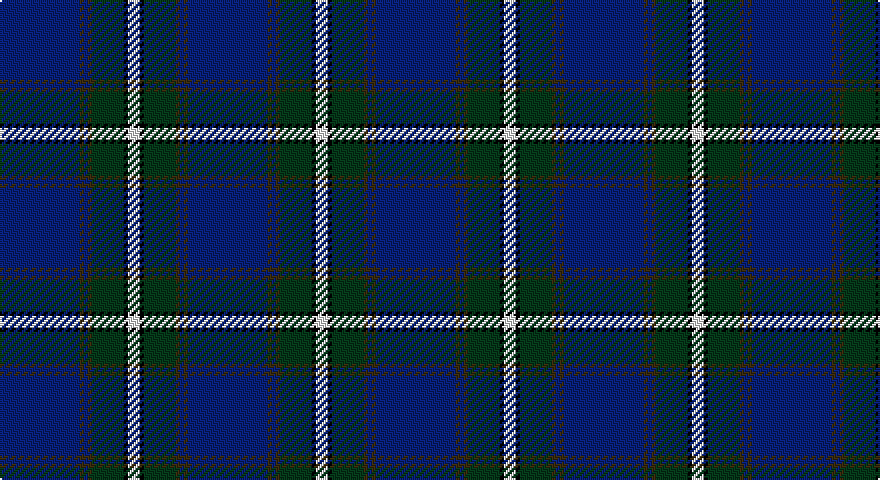
Sample sheet (PDF) — the woven sample, thread count and palette on one printable A4, rendered on demand (the same sheet the TTD print page downloads).
Nearest tartan variants
The nearest existing variants by ΔTartan distance, with this cloth at the top so the swatches line up against it.











Neighbour map
Every grey dot is one of 13662 variants placed by the first two principal components of the ΔTartan feature space (42% of its variance). Red is this tartan; blue dots are its nearest — click one to open its page. The map is a flat projection of a many-dimensional space — how to read it.
ID: /variants/s7/db20dy1db1dy1dg8k1w3~x2/