MacDonald of Borrodale (Clan)
This is one variant — a specific cloth: this exact thread count and colourway, with its own provenance below. It is one weaving of the sett (the scale-free proportion — the same cloth at any scale or shade), whose colour order is pattern RBRBKGGR.
Part of the MacDonald of Borrodale tartan — the named design grouping this sett with its other cloths.
Sourced from tartans-authority. It is a 8 stripe tartan.
Original link http://www.tartansauthority.com/tartan-ferret/display/2584/ — retired · Internet Archive copy
2 attestations — the source records this cloth was collapsed from (oldest owns this page)
- pre 1746 — MacDonald of Borrodale (Clan) (tartans-authority, record)
Swatch from Rosa MacDonald, 1991. Tartan was gift of Lady MacDonald of Borrodale to Prince Charles Edward 1746. Following explanation from the Kirkliston Pipe Band site who use the tartan: "After the Battle of Culloden on 16th April 1746, Prince Charles Edward Stuart was a fugitive in the West Highlands until rescued by French ships in Arisaig on 20th September. His escape took him into the 'safe' Clanranald territory of Morar, Arisaig and Moidart. He was sheltered by Angus and Catriona MacDonald of Borrodale. Six days later the Prince, four companions, Donald MacLeod and seven Clanranalds, sailed for the Outer Hebrides in an eight-oared boat of the Borrodales. As soon as they were clear of the sheltered waters of the sea loch at Arisaig, a violent storm arose. Driven by the gale through the night and in constant danger of capsizing, the boat reached Benbecula where the Prince, his companions and crew hid for two days. They then sailed to Scalpay off Harris where they were hospitably received by Donald Campbell a tenant of MacLeod of Dunvegan, and where the Prince was given a change of clothes. On departure, he left the sea-soaked tartan lately given to him by Lady Borrodale, with Donald Campbell and his family. Two fragments of this tartan cloth are known to have survived. One in the West Highland Museum, Fort William, and the other among a collection of Stuart relics at Stonyhurst College in Lancashire. The pieces were brought together by Peter MacDonald, Handloom Weaver, Crieff, who reconstructed the original tartan, using dyes to match the original colours of indigo blue and cochineal red. The research to authenticate the history of the tartan, was carried out by Mr Tom Massey Lynch on behalf of Stonyhurst College, and the recreated tartan was displayed in the Royal Museum of Scotland by courtesy of the Trustees of the College. " Woven by D C Dalgliesh. - undated — MacDonald of Borrodale (register-of-tartans, record)
Swatch from Rosa MacDonald, 1991. This tartan was a gift by Lady MacDonald of Borrodale to Prince Charles Edward Stuart in 1746. The following explanation is given by the Kirkliston Pipe Band site who use the tartan: 'After the Battle of Culloden on 16th April 1746, Prince Charles Edward Stuart was a fugitive in the West Highlands until rescued by French ships in Arisaig on 20th September. His escape took him into the 'safe' Clanranald territory of Morar, Arisaig and Moidart. He was sheltered by Angus and Catriona MacDonald of Borrodale.' Six days later the Prince, four companions, Donald MacLeod and seven Clanranalds, sailed for the Outer Hebrides in an eight-oared boat of the Borrodales. As soon as they were clear of the sheltered waters of the sea loch at Arisaig, a violent storm arose. Driven by the gale through the night and in constant danger of capsizing, the boat reached Benbecula where the Prince, his companions and crew hid for two days. They then sailed to Scalpay off Harris where they were hospitably received by Donald Campbell, a tenant of MacLeod of Dunvegan, and where the Prince was given a change of clothes. On departure, he left the sea-soaked tartan lately given to him by Lady Borrodale, with Donald Campbell and his family. Two fragments of this tartan cloth are known to have survived. One in the West Highland Museum, Fort William, and the other among a collection of Stuart relics at Stonyhurst College in Lancashire. The pieces were brought together by Peter MacDonald, Handloom Weaver, Crieff, who reconstructed the original tartan, using dyes to match the original colours of indigo blue and cochineal red. The research to authenticate the history of the tartan, was carried out by Mr Tom Massey Lynch on behalf of Stonyhurst College, and the recreated tartan was displayed in the Royal Museum of Scotland by courtesy of the Trustees of the College.' Woven by DC Dalgliesh.
Dataset — provenance for this record, inherited from the source manifest
- source
- Scottish Tartans Authority
- data captured from
- https://github.com/thetartan/tartan-database/blob/master/data/tartans-authority/data.csv
- data date
- pre 1746 (this record)
- licence
- CC BY-NC-ND 4.0
Capture chain — the hands this data passed through, oldest first; each capture carries its own licence
- Scottish Tartans Authority
the heritage body’s archive — its tartan-ferret record browser is retired; dead record links are shown unlinked, with an Internet Archive copy (ITI numbers are not SRT references) - thetartan/tartan-database 2016-2017 · CC BY-NC-ND 4.0
Levko Kravets's frozen compilation — the capture we vendored, and where its CC licence text came from - this dictionary captured 2026-06-10 · commit 5bf86c7566
each re-capture is a git commit to data/sources
Register references
External register numbers recorded for this tartan.
- Scottish Register of Tartans: 2351
- Scottish Tartans Authority (ITI): 2584
- Scottish Tartans World Register: 2584
Thread count
R/12 DB6 R6 DB64 K60 G60 Y6 R/6
One full sett is 422 threads.

Palette
| Colour | Shade | OKLCh |
|---|---|---|
| DB | #082077 #082077 | oklch(30.0% 0.149 265.1) |
| G | #008B2A #008B2A | oklch(55.4% 0.170 145.9) |
| K | #000000 #000000 | oklch(0.0% 0.000 0.0) |
| R | #D60020 #D60020 | oklch(55.2% 0.224 25.5) |
| Y | #8B6E00 #8B6E00 | oklch(55.1% 0.113 90.4) |
Sample pattern
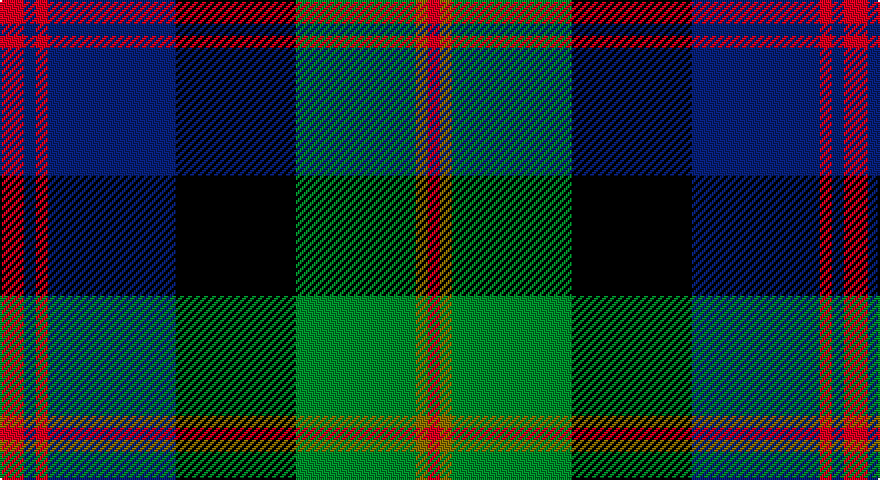
Sample sheet (PDF) — the woven sample, thread count and palette on one printable A4, rendered on demand (the same sheet the TTD print page downloads).
Nearest tartan variants
The nearest existing variants by ΔTartan distance, with this cloth at the top so the swatches line up against it.











Neighbour map
Every grey dot is one of 13662 variants placed by the first two principal components of the ΔTartan feature space (42% of its variance). Red is this tartan; blue dots are its nearest — click one to open its page. The map is a flat projection of a many-dimensional space — how to read it.
ID: /variants/s8/r6db3r3db32k30g30y3r3~x2/