Royal Canadian Air Force
This is one variant — a specific cloth: this exact thread count and colourway, with its own provenance below. It is one weaving of the sett (the scale-free proportion — the same cloth at any scale or shade), whose colour order is pattern RBRBRBRKRKWKWKRKWR.
Part of the Royal Canadian Air Force tartan — the named design grouping this sett with its other cloths.
Sourced from register-of-tartans. It is a 18 stripe tartan.
Original link https://www.tartanregister.gov.uk/tartanDetails.aspx?ref=3591
2 attestations — the source records this cloth was collapsed from (oldest owns this page)
- 01/01/1942 — Royal Canadian Air Force (register-of-tartans, record)
The tartan was created in the early 1940s by Group Captain (G/C) Elmer Fullerton, based on the Anderson tartan and the RCAF colours. Approx 16 yards were woven by Loom Crofters of Gagetown, New Brunswick, Canada, as a sample. It was approved by the Air Council of RCAF on 21 May 1942. A sample of the tartan was submitted to Lord Lyon, King of Arms in Edinburgh, who wrote that he approved of the tartan and would keep the sample. More of the tartan was woven for the pipers and drummers in the RCAF band. - 1942 — Royal Canadian Air Force (Military) (tartans-authority, record)
Notes on an RCAF website: "Truly a unique national treasure, the RCAF Tartan worn by the band has a special pride of place at CFB Trenton. Its creation was sparked in the early 1940s by Group Captain E.G. Fullerton AFC, Commanding Officer of No. 9 Service Flying Training School and later Commanding Officer of RCAF Station Trenton." At that time the Edinburgh company of Wm Anderson (now Kinloch Anderson Ltd) had substantial military business in Canada and Mr Kinloch Anderson was apparently asked to design a tartan for the RCAF. That he did - based on the Anderson tartan - and it's thought that the Loomcrofters of Gagetown in New Brunswick, Canada may have woven some prototype samples which possibly has given rise to the claim that they designed the tartan. After modification by the Air Council, the design received official sanction from Air Force Headquarters on 21 May 1942. The tartan was submitted to Lord Lyon, King of Arms in Edinburgh for approval in July 1942. In reality he had no power to approve or disapprove and he merely 'noted' its existance although it's frequently and erroneously claimed that he granted approval on 15 August 1942 and it became officially known worldwide as The Royal Canadian Air Force Tartan. With the amalgamation of Canada's three military services in 1968, the distinctive blue Air Force uniform was lost for over 20 years. This was a time of profound change for Canada's military, when unit titles, insignia, and all distinguishing hallmarks of the Army, Navy, and Air Force were officially proscribed in favour of a singular, generic-looking force. In hindsight, it is incredible that the RCAF Tartan survived, for amid the post-integration haste for uniformity, precious swatches of the original tartan samples were incinerated, and its official documentation hung in oblivion. Thanks to the prudence of the RCAF Association, a piece of Air Force - indeed national - heritage was carefully preserved. Today, as much as ever, its colours reflect the mettle of a proud, professional Service. Designed by Mr W.J. Kinloch Anderson of Kinloch Anderson Ltd and based on the Anderson tartan. Originally woven by Peter MacArthur. STS comments "The threadcount was provided by M. Lawrence of the Canadian Defence Department in Ottawa. Colours specified as dark blue, light blue and maroon. The orignal thread count was: M4, A6, K1, M2, K1, A14, K3, W3, K2, M2, K2, M2, DB4, M2, DB6, M2, DB6, M3. It is unusual to have a single strand used in a thread count as it is impossible to turn the thread on the 'kilt edge'. The following is from D C Stewart's NOMINDEX "No RCAF tartan is registered with the Lyon Court but a letter exists in which Lyon acknowledges letter with details from the RCAF and merely comments that he had 'noted' it. This caused much confusion and gave rise to the strong rumour that Lyon (Sir Francis Grant) had 'registered' the tartan. The specimen in the Scottish United Services Museum is claimed to have been 'approved' by Lord Lyon - this is not the case." For display purposes the count has been doubled in this graphic. "Of the original Anderson tartan (#1394) James D Scarlett MBE noted in his 1975 book "The Tartans of the Scottish Clans" : The origin of this tartan is unknown, but the type of pattern suggests that it had its basis in one of the 'fancy' types of design that were becoming popular in the few years immediately preceding the great 'tartan explosion' that was touched off by the 1822 royal visit to Edinburgh. There was a ready sale for such patterns in the days when they could be worn for reasons of preference, and several of them, the Anderson among them, passed to posterity as clan tartans."
Dataset — provenance for this record, inherited from the source manifest
- source
- Scottish Register of Tartans
- data captured from
- https://github.com/thetartan/tartan-database/blob/master/data/register-of-tartans/data.csv
- data date
- 1942 (this record)
- licence
- Crown copyright
Capture chain — the hands this data passed through, oldest first; each capture carries its own licence
- Scottish Register of Tartans · Crown copyright
the living register — still published by National Records of Scotland - thetartan/tartan-database 2016-2017 · CC BY-NC-ND 4.0
Levko Kravets's frozen compilation — the capture we vendored, and where its CC licence text came from - this dictionary captured 2026-06-10 · commit 5bf86c7566
each re-capture is a git commit to data/sources
Register references
External register numbers recorded for this tartan.
- Scottish Register of Tartans: 3591
- Scottish Tartans Authority (ITI): 1343
- Scottish Tartans World Register: 1343
Thread count
R/8 LB12 K2 R4 K2 LB28 K6 W6 K4 R4 K4 R4 DB8 R4 DB12 R4 DB12 R/4
One full sett is 244 threads.

Palette
| Colour | Shade | OKLCh |
|---|---|---|
| LB | #B5BBDE #B5BBDE | oklch(79.9% 0.050 277.6) |
| DB | #082077 #082077 | oklch(30.0% 0.149 265.1) |
| K | #000000 #000000 | oklch(0.0% 0.000 0.0) |
| W | #F7F7F7 #F7F7F7 | oklch(97.6% 0.000 89.9) |
| R | #D60020 #D60020 | oklch(55.2% 0.224 25.5) |
Sample pattern
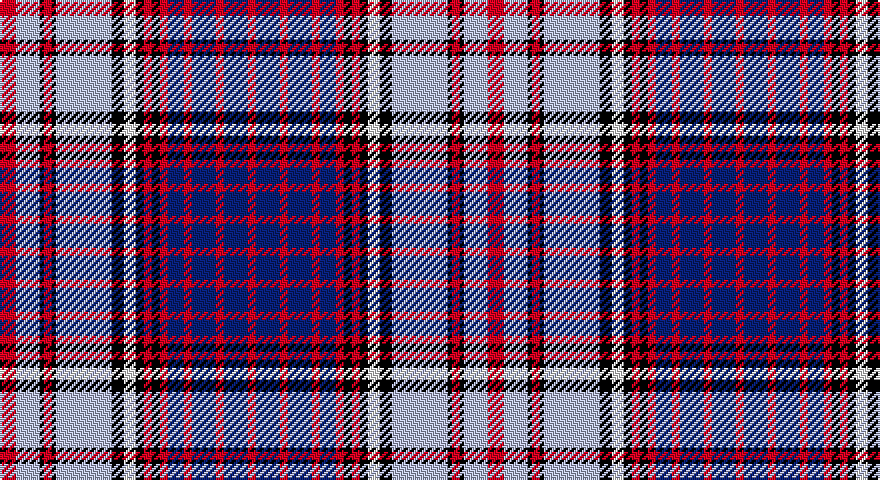
Sample sheet (PDF) — the woven sample, thread count and palette on one printable A4, rendered on demand (the same sheet the TTD print page downloads).
Nearest tartan variants
The nearest existing variants by ΔTartan distance, with this cloth at the top so the swatches line up against it.











Neighbour map
Every grey dot is one of 13662 variants placed by the first two principal components of the ΔTartan feature space (42% of its variance). Red is this tartan; blue dots are its nearest — click one to open its page. The map is a flat projection of a many-dimensional space — how to read it.
ID: /variants/s18/r4lb6k1r2k1lb14k3w3k2r2k2r2db4r2db6r2db6r2~x2/