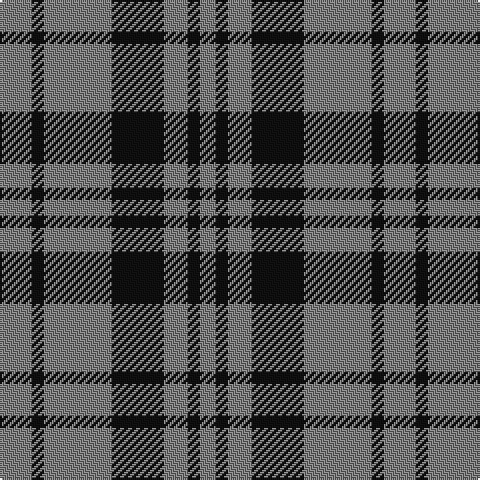
Scott Black and Grey
In pattern GKGKGKG.
This was sourced from register-of-tartans. It is a 7 stripe tartan.
Original link https://www.tartanregister.gov.uk/tartanDetails.aspx?ref=3696
Also known as
This cloth is also recorded under:
- Scott Black & Grey
Register references
External register numbers recorded for this tartan.
- Scottish Register of Tartans: 3696
- Scottish Tartans World Register: 1287
Thread count
N/16 K6 N34 K26 N12 K6 N/8

Palette
Each colour and its ΔE from the base-6 reference it is a variant of.
| Colour | Shade | Base | ΔE (OKLab) |
|---|---|---|---|
| K | #101010 #101010 | K #000000 | 0.17 |
| N | #808080 #808080 | G #006100 | 0.23 |
Sample pattern
Nearest tartans
The nearest existing variants by ΔTartan distance.
- Scott Black & Grey (Corporate) — ΔT 0.25
- Bute Heather, Black — ΔT 1.49
- Unidentified Sample — ΔT 1.50
- Wilson's, No 211 — ΔT 1.55
- Tokharion — ΔT 1.62
- Special Saffron — ΔT 1.67
- Latin — ΔT 1.70
- Douglas, Grey (Vestiarium Scoticum) — ΔT 1.77
- Grey Breton — ΔT 1.79
- Elphinstone Clan Tartan Tartan Number: 115. Earliest known date: 1842 The village of Elphinstone is next to Tranent near Edinburgh in East Lothian. Sir Henry Elphinstone of Pittendriech in Midlothian was created Baron Elphinstone in 1509 and fell at Flodden Field. The Elphinstone tartan first appeared in the text of the Vestiarium Scoticum (1842). It is similar to some extent with the Montgomerie tartan and to the Montgomerie Hunting sett, suggesting a link to an early provenance. D.W. Stewart (1893) maintained that he could date the Montgomerie of Eglinton to 1707. See products available Copyright © Blair Urquhart, Comrie, 2015 — ΔT 1.79
Neighbour map
Every grey dot is one of 14299 variants placed by the first two principal components of the ΔTartan feature space (44% of its variance). Red is this tartan; blue dots are its nearest — click one to open its page.
ID: /setts/s7/y8k3y17k13y6k3y4~x2/