For two centuries the Drummonds of Megginch have worn one tartan, and for two centuries no two weavings of it have been quite the same. The collection held at Megginch Castle — a plaid, three kilts, a child's kilt, even a carpet — is the same design at different scales, in different dyes, at different states of fading. This post gathers the whole collection in one place: every artefact, every thread count, every shade we have measured, and a printable poster of the lot.
Family tradition ties the first wearing to the royal visit of George IV to Edinburgh, and the oldest surviving cloth dates from about then. Admiral Adam Drummond worte on August 27th, 1823 "Our gaietes I am happy to say is nearly at an end, and the affection, loyalty, good order and dignity of our countryman on this memorable occasion will neve I am sure be effaced from the mind of the King or his friends who accopmpanied him. He leaves us on the 29th and embarks in his yacht. Rober, James, Charles and their cousins all marched in the procession of the highanders fully accoutred in their Highland garb, and look all I could desire and wish. You may tell our Chief and clansmen Mr Drummond that we set our feet to support the ancient House of Concraig." p223 Castle of Dreams by Cherry Drummond.
Each piece has its own post with the detective work; this is the catalogue.
The collection at a glance
| Date | Artefact | Thread count | Woven on demand |
|---|---|---|---|
| c. 1820 | Plaid | R/26 DB2 R6 DB6 R126 LB6 R6 DB38 R6 G6 R6 G130 R19 DB6 R/18 | variant page |
| 1849 | Kilt | R/14 DB2 R4 DB4 R70 LB4 R4 DB20 R4 G4 R4 G74 R6 DB4 R/12 | variant page |
| 1849 | Kilt, faded outer face | same sett, lightened dyes | variant page |
| c. 1890 | Child's kilt | R12 DB2 R4 DB4 R28 LB4 R4 DB8 R4 G4 R4 G24 R6 DB4 R12 | variant page |
| 1967 | Carpet | not yet recorded | — |
| 1997 | Kilt | DR/12 DN2 DR4 DN4 DR62 LB4 DR4 DN20 DR4 N4 DR4 N64 DR6 DN4 DR/14 | variant page |
| 2022 | Proposal | 1849 sett, new shades | 1849 sett (not yet in the corpus as its own variant) |
| 2023 | Kilt | 1849 sett, shades as woven | variant page |
The family's tartans are also listed on the Drummond of Megginch family page and under Clan Drummond.
c. 1820 — the plaid
The oldest piece is a plaid thought to date from around 1820, woven at roughly double the thread count of everything that followed — the original pattern at full scale. Its precise early history is uncertain, but its later history is well documented: my mother wore it for our wedding (the picture made Tatler's site), and Liam Neeson sat on it for a Vanity Fair feature in December 1994.

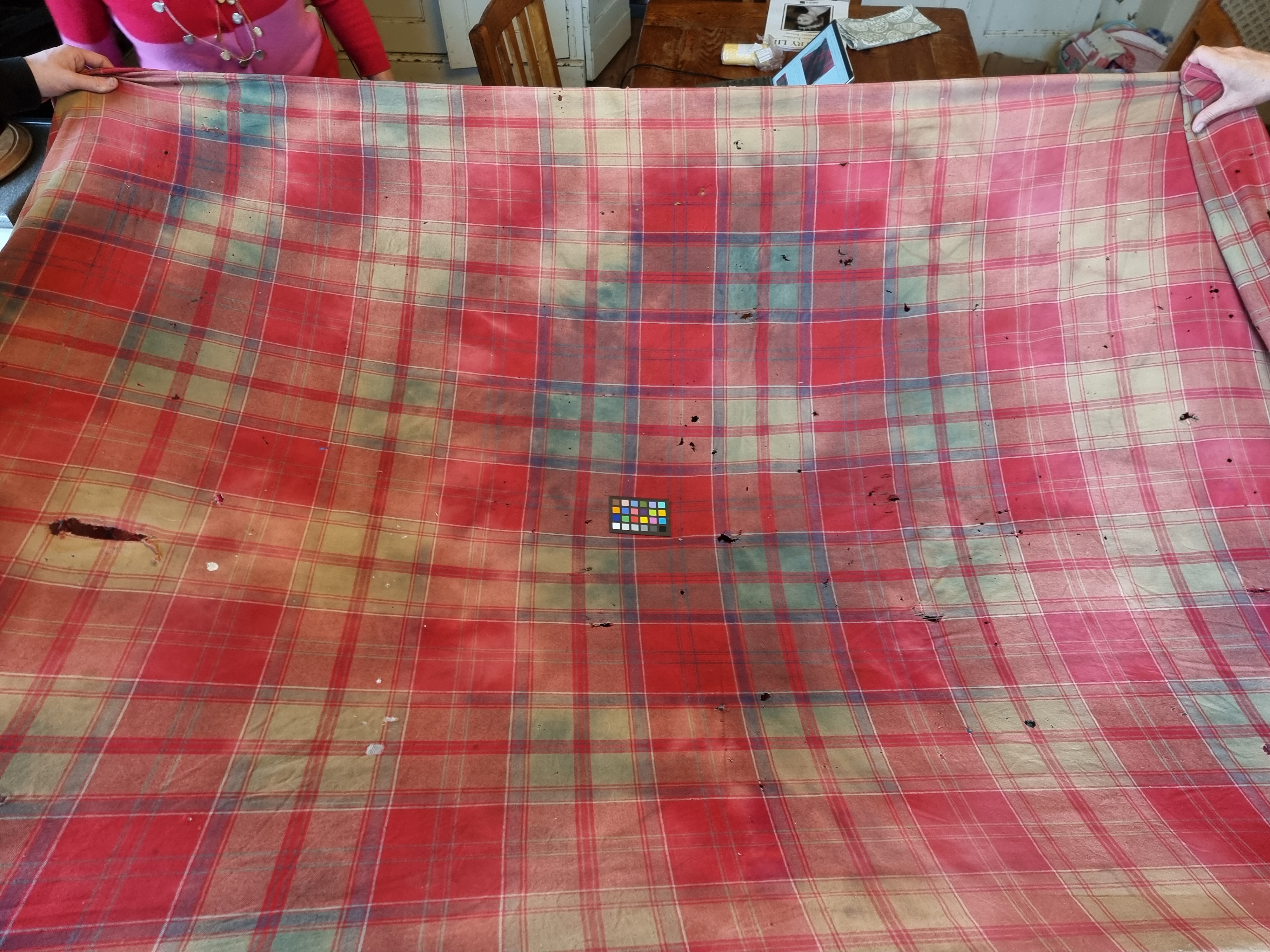
The thread count was read square by square from one of the best unfaded patches — the full analysis, with the detail photographs, is in the plaid's own post. Scale the plaid's count by half and round, and the 1849 kilt falls out almost exactly.
1849 — the kilt, twice over
The anchor of the collection. The kilt can be dated with confidence: a photograph shows JMD (James Murray Drummond) wearing it with a sporran that survives alongside it, and the sporran's Edinburgh silver maker's mark reads 1849. I wore the kilt myself from about 1975 to 2000.
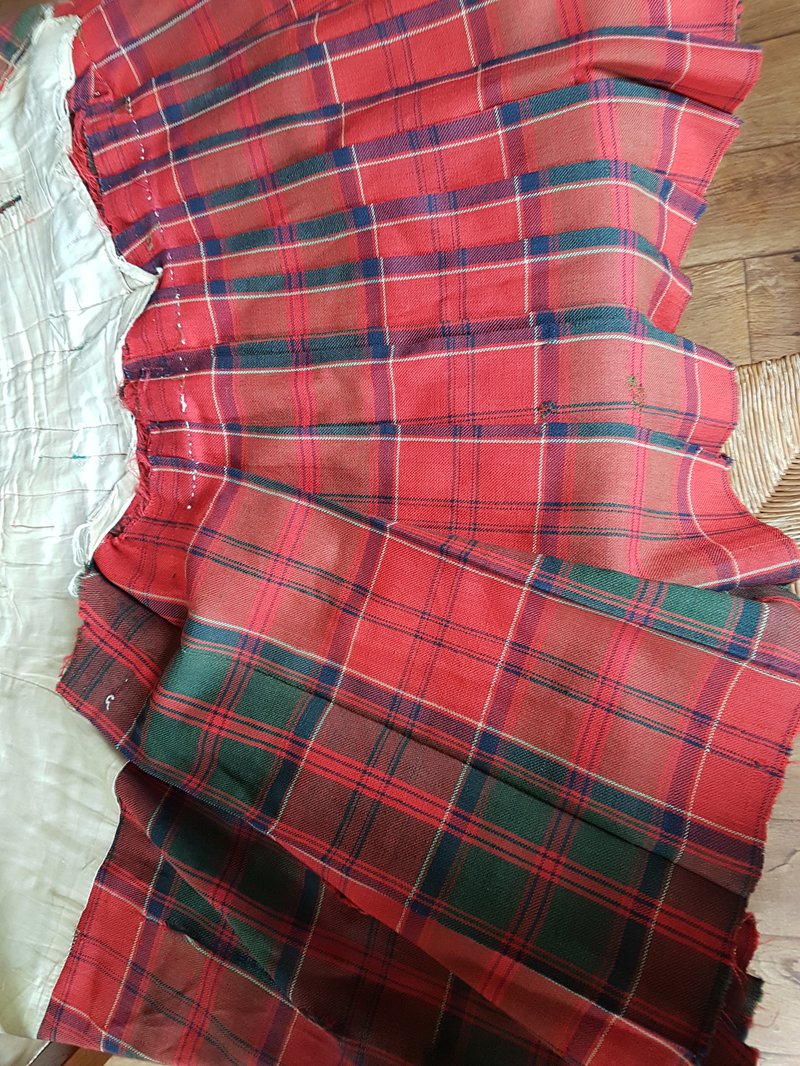
It earns two entries in the catalogue because it is two colourways in one garment: the inside keeps something close to the original dyes, while the outer face has been lightened by a century and a half of sun and wear. Recording both faces gives the Dictionary a rare thing — a dye-fade pair, the same sett in fresh and faded shades, from a single piece of cloth.
c. 1890 — the child's kilt
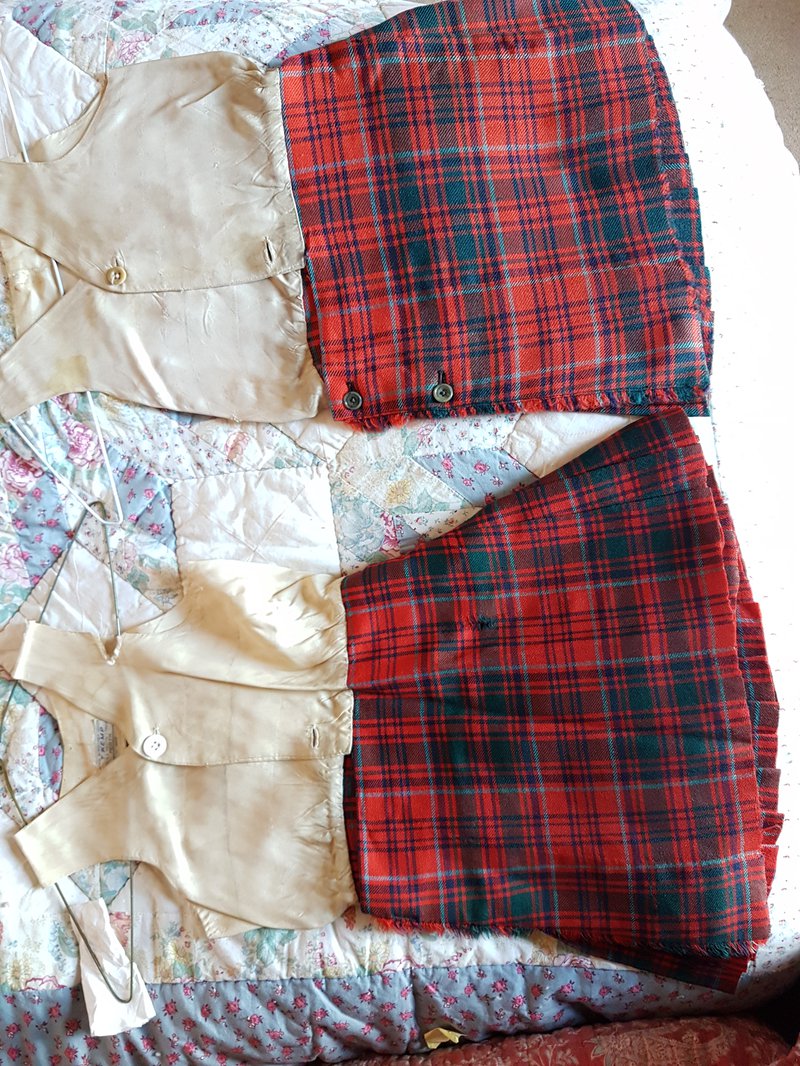
The Victorian children's kilts use a different thread count again: the two big fields of red and green are cut down so that the design reads correctly on a small garment, rather than shrinking every stripe alike.
1967 — the carpet
The design even reached the floor: a carpet woven in 1967. Its thread count has not yet been recorded, so it sits in the catalogue as a placeholder for now.
1997 — the wedding kilt
For my wedding in 1997 a new kilt was woven by DC Dalgleish in Selkirk. The mill both adjusted the count slightly and muted the shades — the dark blue came out at RGB 40 44 57, nearer a charcoal navy than the old bright blue. Details in the 1997 kilt's post.
2022–2023 — the proposal and the new kilt
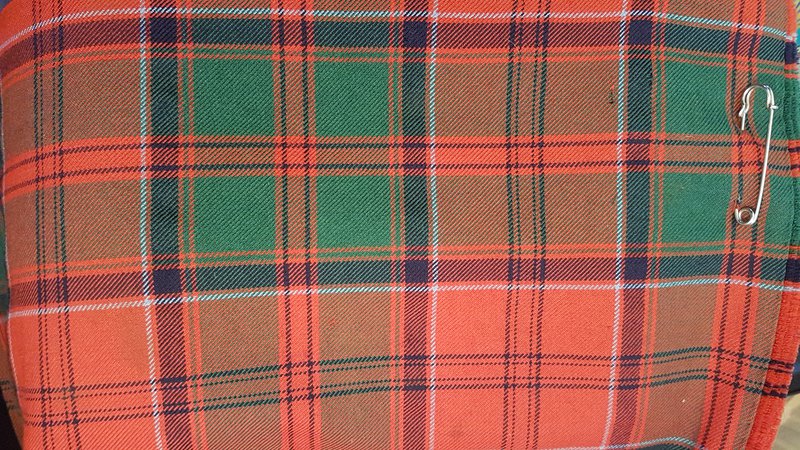
In 2022, working with Lexa and Bertie, we drew up a proposal returning to the 1849 thread count with a freshly chosen palette — Pantone 180 (red), 654 (dark blue), 543 (light blue) and 364 (green). A sample was woven, including a gold-striped variation:
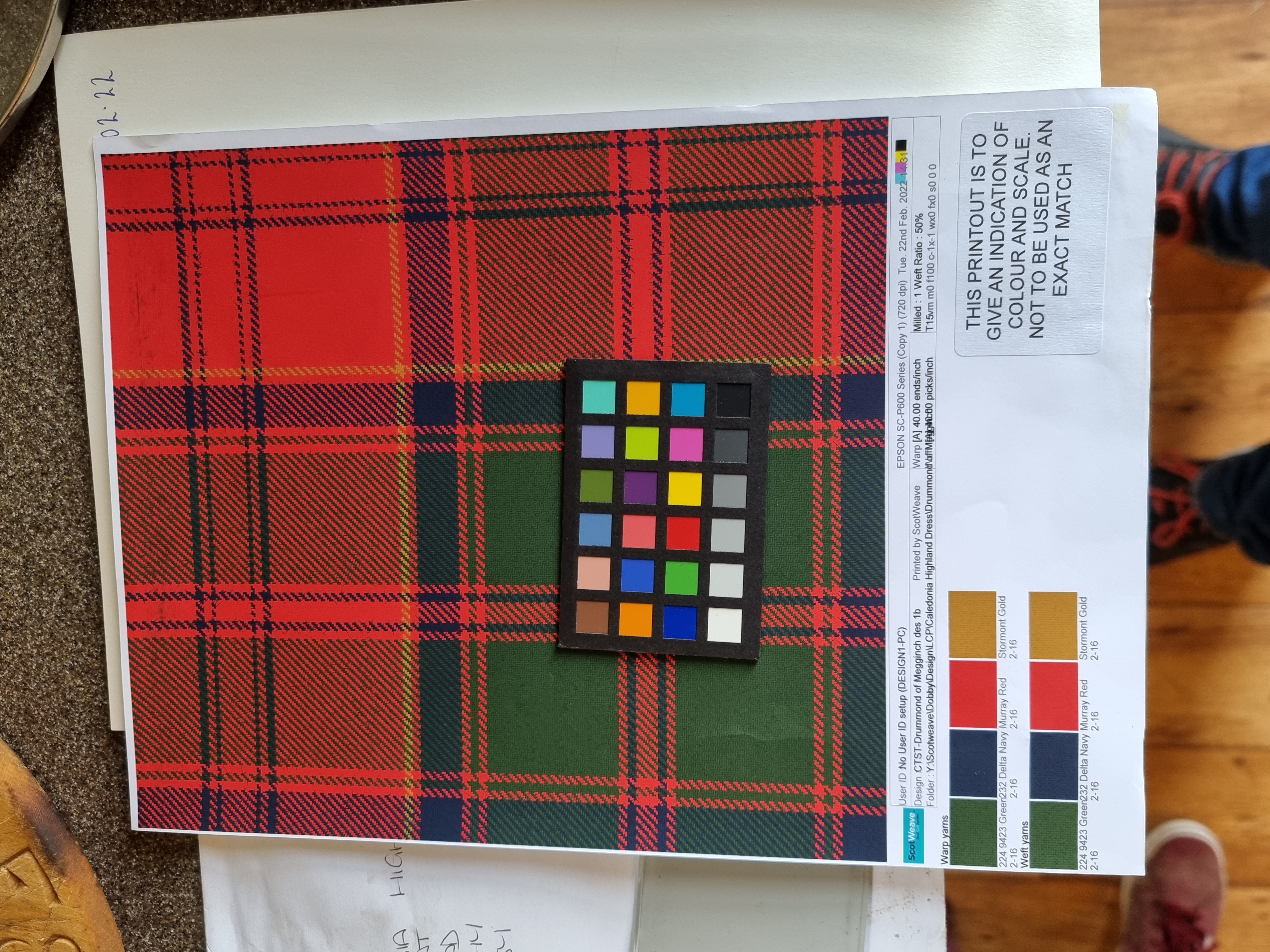
The 2023 kilt is that proposal made real: the 1849 sett, in the new shades as they came off the loom. The full proposal, with all the candidate colourways, is in its own post.
The shades
Five colourways of one design, measured in sRGB:
| Weaving | Red | Dark blue | Light blue | Green |
|---|---|---|---|---|
| 1820 / 1849 / child's | #C80000 | #000064 | #98C8E8 | #004C00 |
| 1849 faded face | #C13828 | #0F2B5B | #93B7D1 | #3A7728 |
| 1997 kilt | #983029 | #282C39 | #98C8E8 | #304F45 |
| 2022 proposal | #BE3A34 | #003A70 | #A4C8E1 | #4A7729 |
| 2023 kilt | #C23C33 | #003A70 | #A4C7E2 | #49762A |
One pattern, many cloths
Lay the thread counts side by side and no two artefacts agree; lay the cloths side by side and they are unmistakably one tartan. That is the Dictionary's central claim made flesh: identity lives at the level of the pattern — RBRBRWRBRGRGRBR — not the recipe. The collection holds the same design at three scales (plaid, kilt, child's kilt) and in five shadings (original, faded, muted, proposed, woven), and every one of them reduces to that single fifteen-stripe pattern.
It also settles an old confusion. The Megginch tartan has long been muddled with the pattern Wilson's 1819 book records as New Bruce — called Grant or Drummond depending on who you read. Seen as patterns they separate cleanly: in the Wilson design the small azure square is about 85% the side of the large one; in every Megginch weaving it is about 65%. The full argument is in the original tartan notes.
Because the artefacts are first-hand — cloth in hand, not catalogue entries — the collection also serves as ground truth for the Dictionary's engine: the dye-fade pair tests whether re-colourings collapse together, and the three scales test whether rescalings do.
The poster
Everything above, on one sheet. The poster is woven on demand in your browser from the thread counts — the 1820 plaid as a full-width band across the top, the six later weavings beneath it, each with its thread count. Pick a size and use your browser's print dialogue to print it or save it as a PDF.
Print the collection poster: